Ukraine strikes Russian oil tankers and oil depots far behind the front line with drones
Berlin, July 9, 2026
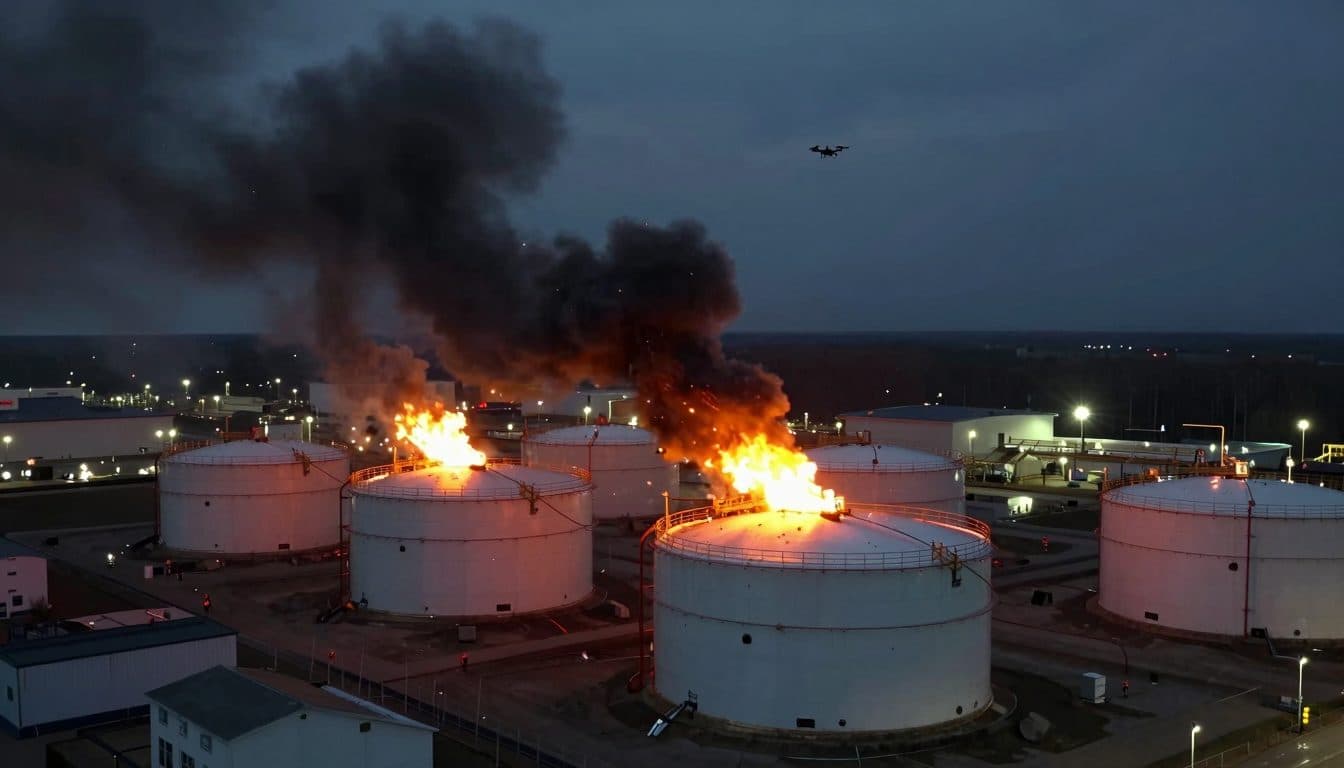
AI-generated image (z-image via Kie.ai)
Summary
According to President Volodymyr Zelensky, Ukraine attacked two Russian oil depots in the Tver and Stavropol regions as well as several ships in the Sea of Azov with drones during the night of July 9. Meanwhile, Russian drones reportedly struck several Ukrainian cities, with Ukrainian authorities reporting at least 14 killed and numerous injured.
Berlin, July 9, 2026
According to President Volodymyr Zelensky, Ukraine attacked two Russian oil depots in the Tver and Stavropol regions as well as several ships in the Sea of Azov with drones during the night of July 9, 2026.
Attacks on Russian infrastructure
According to Zelensky, the strikes on the oil depots occurred around 500 kilometers from the front line. „Die Ukraine hat nach Angaben von Präsident Wolodymyr Selenskyj zwei russische Öllager in den Regionen Twer und Stawropol angegriffen." At the same time, drones hit a loading terminal in Bataysk in Russia's Rostov region: „Zudem hätten Drohnen ein Verladeterminal in Batajsk in der russischen Region Rostow in Brand gesetzt."
In the Sea of Azov, two tankers caught fire during a Ukrainian drone attack, the governor of the southern Russian Rostov region, Yuri Slyusar, announced on Telegram. „Die Besatzungen der Schiffe seien in Sicherheit gebracht worden. Auf beiden Schiffen seien Brände ausgebrochen, das Feuer auf einem Schiff sei rasch gelöscht worden, hieß es weiter." According to Slyusar, two tankers were affected, set ablaze by drones.
Shadow fleet in the Sea of Azov
According to the Ukrainian General Staff, the number of ships hit in the Sea of Azov was significantly higher. „Die ukrainischen Streitkräfte haben nach Angaben des Generalstabs in der Nacht zum 9. Juli zwölf Öltanker, ein Bugsierschiff und einen Frachter im Asowschen Meer getroffen." According to Kyiv's account, the ships struck were not civilian freighters but units of the so-called Russian shadow fleet. „Wie der Generalstab auf Facebook mitteilte, versorgten die Schiffe die russische Armee mit Treibstoff und wurden zur Umgehung der Öl-Sanktionen genutzt." In recent days, Ukraine says it has already attacked several tankers of this fleet, which Moscow's leadership uses to circumvent Western sanctions.
The attacks on Russian infrastructure were accompanied by strikes on Ukrainian territory. „Nach ukrainischen Behördenangaben wurden in der Nacht zum Mittwoch mindestens sieben Menschen getötet, unter anderem in Mykolajiw, Charkiw und Cherson." In the port city of Odesa, more people were killed according to the local military administration: „In Odessa starben nach Angaben der örtlichen Militärverwaltung mindestens vier Menschen bei einem Raketenangriff." In the capital Kyiv, the situation worsened during the day. „In Kiew meldete Bürgermeister Vitali Klitschko später mindestens drei Tote und zehn Verletzte durch Drohnenangriffe."
Counterattacks on Ukrainian cities
Russia's Defense Ministry meanwhile said its own air defenses had shot down hundreds of Ukrainian drones in recent hours. „Das russische Verteidigungsministerium meldete den Abschuss Hunderter ukrainischer Drohnen." It remained unclear which of these figures referred to the day and which to a longer period.
Parallel to the military developments, a summit meeting between Polish President Karol Nawrocki and Ukrainian President Volodymyr Zelensky took place on the sidelines of the NATO summit in Ankara. „Trotz des jüngsten Streits um die Weltkriegsvergangenheit haben Polens Präsident Karol Nawrocki und der ukrainische Präsident Wolodymyr Selenskyj am Rande des Nato-Gipfels in Ankara ihren Dialog fortgesetzt." Nawrocki used the meeting to warn against Russia once again: „Nawrocki betonte zugleich, Russland bleibe die größte Bedrohung für Polen und die Ukraine." However, no rapprochement was achieved on the historical disputes: „Eine Einigung in den historischen Streitfragen sei jedoch nicht erzielt worden, sagte Nawrocki."
Summit in Ankara: NATO promises billions in aid
The background to the Polish-Ukrainian conflict is the naming of a Ukrainian military unit. „Auslöser des Konflikts ist die Benennung einer ukrainischen Armeeeinheit nach der Ukrainischen Aufstandsarmee (UPA), die in Polen für Massaker an Zehntausenden Polen und Juden im Zweiten Weltkrieg verantwortlich gemacht wird." The dispute over this has strained relations between the two states for weeks, even though the summit in Ankara has now made it possible to continue the dialogue.
At the Ankara summit, NATO assured Ukraine of further extensive military aid, according to alliance sources. „NATO pledged at least the same amount, 70 billion euros, in military aid to Ukraine for 2027." This sum also includes an EU aid package: „Ein EU-Hilfspaket von rund 60 Milliarden Euro bis Ende 2027 wird dabei mitgerechnet." The funds are intended, among other things, to finance the expansion of Ukrainian air defense and drone programs.
Russia responds with criticism and diesel ban
In connection with the summit, Zelensky also announced bilateral agreements. „Selenskyj vereinbarte zudem neue Drohnen-Abkommen mit Estland, den Niederlanden und Dänemark." The Ukrainian president also used the occasion in Ankara to advocate for expanding Western arms production on Ukrainian soil. According to sources in Washington, US President Donald Trump announced „dass die Ukraine künftig Patriot-Luftabwehrraketen in Lizenz herstellen darf."
The Russian side reacted with sharp criticism to the summit's decisions. „Das russische Außenministerium warf den europäischen Nato-Staaten vor, sich auf einen bewaffneten Konflikt mit Russland vorzubereiten. Die Entscheidungen seien „verantwortungslos" und könnten in eine Katastrophe führen." At the same time, Moscow intensified economic pressure: „Wegen Engpässen verhängte Russland ein Exportverbot für Diesel." The export ban points to supply problems in Russia's energy sector, which are also linked to Ukrainian attacks on refineries and tankers.
There is also continued movement in the case of the blown-up Nord Stream pipelines. „Im Fall der gesprengten Nord-Stream-Pipelines hat die Generalstaatsanwaltschaft in Kiew deutsche Mutmaßungen über eine Beteiligung staatlicher Stellen in der Ukraine zurückgewiesen." The authority stated: „Bislang gebe es keine Hinweise darauf, dass ukrainische Behörden oder einzelne Amtsträger an den Anschlägen im September 2022 in der Ostsee beteiligt gewesen seien oder entsprechende Anweisungen erteilt hätten." Ukraine is thus once again rejecting the suspicions circulating in Germany.
Nord Stream investigations: Kyiv rejects allegations
Overall, the night of July 9 illustrates the escalation dynamic of the Russian-Ukrainian conflict: Ukraine is expanding its drone strikes deep into the Russian hinterland, Russia is responding with massive airstrikes on Ukrainian cities. At the same time, Western allies are trying to strengthen Ukraine with additional billions in aid and new arms agreements, while Russia is reacting with a diesel export ban and sharp diplomatic rhetoric. A diplomatic solution to the conflict is not in sight.
The reporting was broadcast on the program Deutschlandfunk on July 9, 2026. The development of the situation in the coming days, in particular possible Russian retaliatory strikes on Ukrainian energy infrastructure, is likely to determine whether the NATO states can actually mobilize their announced aid in full.
Questions & Answers
What targets did Ukraine attack during the night of July 9?
According to the Ukrainian General Staff and President Volodymyr Zelensky, two oil depots in the Russian regions of Tver and Stavropol, a loading terminal in Bataysk, as well as twelve oil tankers, a tugboat, and a freighter in the Sea of Azov were hit.
How many people were killed in Russian attacks on Ukraine?
Ukrainian authorities reported at least seven killed in Mykolaiv, Kharkiv, and Kherson, as well as at least four killed in Odesa by missile strikes; Kyiv Mayor Vitali Klitschko also spoke of at least three killed and ten injured by drone attacks in Kyiv.
What aid did NATO pledge to Ukraine at the Ankara summit?
According to its own statements, NATO pledged at least 70 billion euros in military aid for 2027, which also includes an EU aid package of around 60 billion euros until the end of 2027; drone agreements were also concluded with Estonia, the Netherlands, and Denmark, and the licensed production of Patriot air defense missiles in Ukraine was announced.
Ukraine attacks Russian tankers and oil depots with drones | allfacts360