Strait of Hormuz: US reimposes naval blockade – 20% levy | allfacts360
US announces naval blockade against Iranian ports and demands 20 percent levy on cargoes through the Strait of Hormuz
Berlin, July 13, 2026
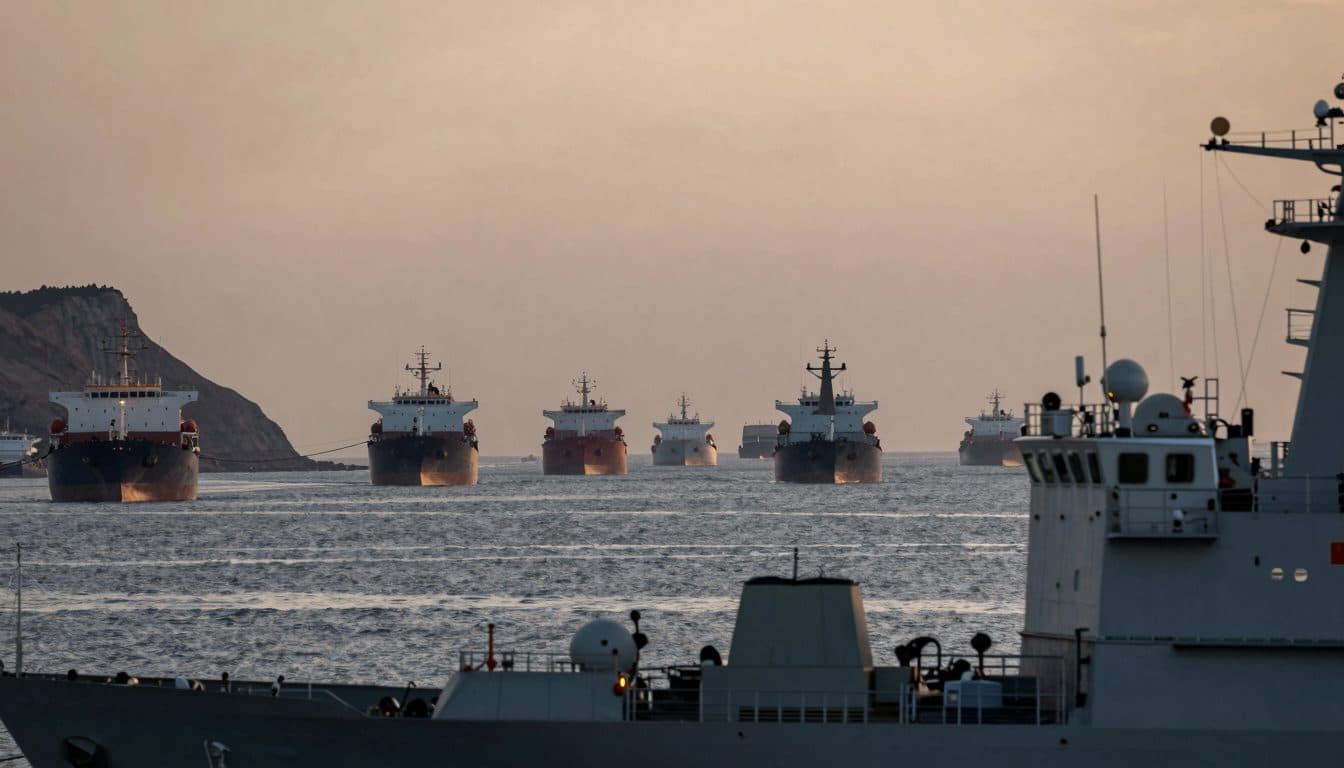
AI-generated image (z-image via Kie.ai)
Summary
US President Donald Trump has announced the resumption of a naval blockade against ships heading to or departing from Iranian ports. At the same time, he is demanding a 20 percent levy on all goods transported through the strait – Tehran rejects this emphatically.
Berlin, July 13, 2026
US President Donald Trump announced on Monday the resumption of a naval blockade against ships heading to or departing from Iranian ports, and at the same time demanded a 20 percent levy on all goods transported through the Strait of Hormuz.
Background to the new naval blockade
According to the responsible regional command Centcom, the measure is to take effect from Tuesday afternoon US East Coast time – corresponding to 10 pm German time – and is to cover the entire Iranian coast including all ports and oil terminals. Trump justified his step with the argument that the US could not provide the protection of the strait "for free." On his platform Truth Social, he specified that the United States wanted to be compensated for all necessary costs to guarantee security "in this very troubled part of the world" with a rate of 20 percent on all shipped cargoes.
Trump had already declared his intention in the morning (US local time) in a phone call with the broadcaster Fox News to take control of the strait. "We will keep the strait, probably operate it and become the guardian of the strait," he said. All other countries should be granted "fair and open" access to the strait. He added that the Strait of Hormuz was "open and will remain open, with or without Iran."
Iran had already agreed to such a arrangement: In the agreement between the US and Iran, Tehran committed to using its "best efforts" to ensure safe and toll-free passage of commercial vessels through the strait for 60 days. The US measure now announced effectively calls this provision into question.
Tehran resists US dictates
A sharp reaction came promptly from Tehran: that the United States was intervening in the Strait of Hormuz would "not be tolerated under any circumstances," it was said on the Iranian side. A direct confrontation between the two governments is thus looming – only a few days after a laboriously negotiated arrangement.
Impact on shipping traffic
Even before the war began, according to data from provider Kpler, more than 100 ships on average passed through the strait daily. On Sunday, according to the information, there were only 14 ships – the lowest value this month. US armed forces had previously diverted more than 140 ships. Nine additional ships reportedly refused to cooperate and were "rendered inoperable." These figures make clear how severely traffic through the strait has already been impaired by the conflict.
With the naval blockade and the announced levy, the US government is intervening deeply in the global logic of the energy markets. A significant share of international oil trade passes through the strait. Iran economist Barbara Dienstbier explained the background on Deutschlandfunk: "The economic machinery of the Revolutionary Guards is a major factor for this group," she said. "That means they even profit from the precarious situation of their own country." According to her, parts of the Iranian leadership even see the war as an opportunity to expand their own influence in the energy sector.
Trump had announced on Truth Social that the US would "for the safe passage of the strait, for reasons of fairness, claim revenues amounting to 20 percent of the cargo value." Secretary of State Marco Rubio said on this: "You can call it a toll or a fee." As a result, the measure looks less like a classic blockade and more like a levy on shipping traffic.
What consequences this will have for the supply of Brent and other crude oil grades remains open. In recent weeks, uncertainty in the region has already led to price swings on the international energy markets. Should the blockade actually take effect on Tuesday evening, further shortages and rising prices are to be expected.
Possible consequences for energy prices
International reactions to the US government's move are still pending. The International Maritime Organization (IMO) had recently expressed concern about the risks to civil shipping in the region, but has not taken any concrete measures. European governments have also not officially commented so far – they are likely to watch the development closely, as European merchant ships also pass through the strait.
The US government had already imposed the blockade weeks ago, but suspended it after bilateral talks with Iran. Now that Trump is reinstating it, relations between Washington and Tehran are heading toward a new level of escalation. The US government is thus pursuing a policy of maximum pressure – and accepting the burden on world trade in the process.
Reactions from abroad
The coming 24 hours will show whether Iran makes good on its threat and obstructs US ships, or whether the blockade is enforced without direct military clashes. Both sides have publicly embarked on a course of confrontation.
Should the situation escalate further, this is likely to have immediate effects on energy prices in Germany and Europe. According to government circles, the German government is closely monitoring the development but has not yet officially commented.
With the resumption of the blockade and the imposition of a 20 percent levy on all cargoes through the strait, the Trump administration is pursuing two goals simultaneously: It wants to put Iran under economic pressure while at the same time recouping its own costs for the military security of the strait. Tehran has made clear that it will not accept this line.
The tensions in the region have thus reached a new peak on July 13, 2026. Observers expect that the coming days will be decisive in determining whether the conflict escalates further or whether a diplomatic solution can be found.
As surprising as the step may appear at first glance, it fits into a line that Trump has been pursuing for months: maximum sanctions, military presence, and the linking of economic and security policy demands. The 20 percent levy is therefore less of a break than an intensification of this strategy.
Questions & Answers
What did US President Donald Trump announce on July 13, 2026?
Trump announced the resumption of a naval blockade against ships heading to or leaving Iranian ports, as well as a 20 percent levy on all goods transported through the Strait of Hormuz.
When is the naval blockade to take effect?
According to the regional command Centcom, the measure applies from Tuesday afternoon US East Coast time, which corresponds to 10 pm German time.
How is Iran reacting to the US announcement?
From Tehran came a clear rejection of US intervention in the Strait of Hormuz – this would "not be tolerated under any circumstances."