US House Passes Resolution Against Trump's Iran War – Veto Looms
Washington, June 04, 2026
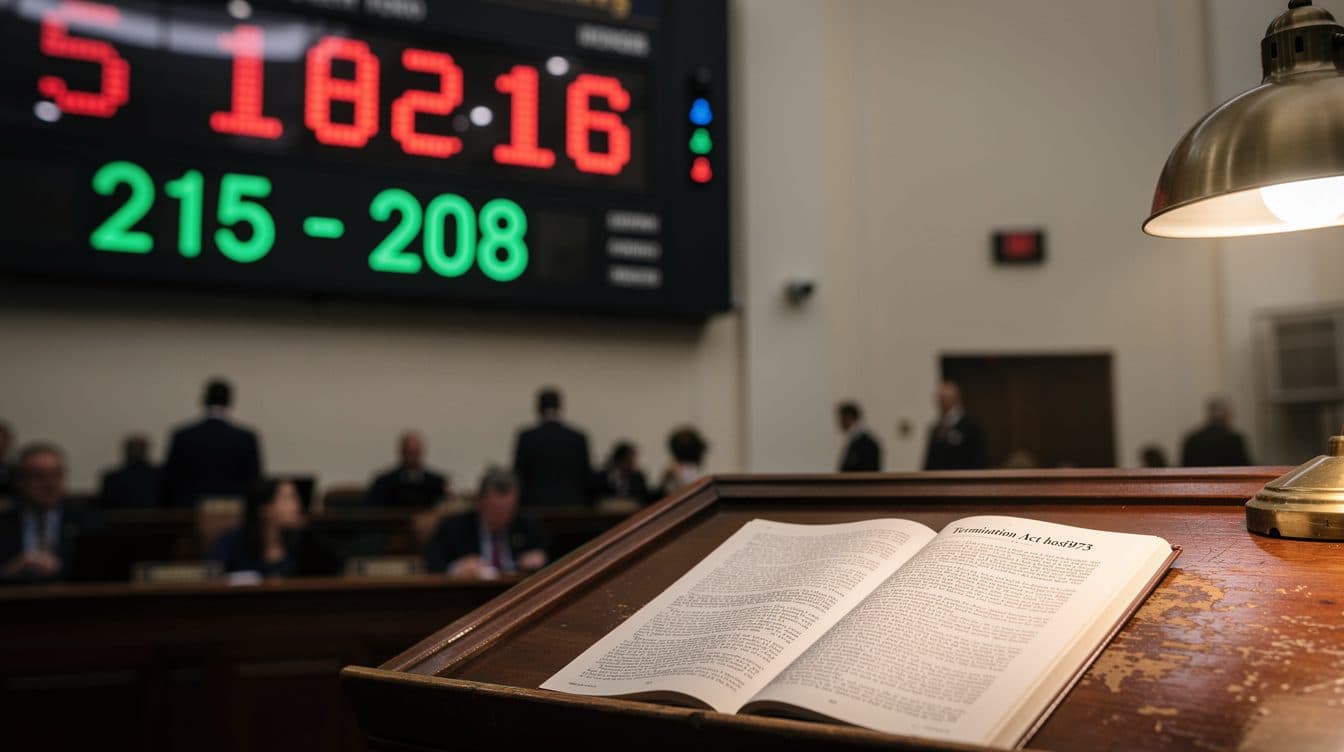
AI-generated image (flux-2/pro-text-to-image via Kie.ai)
Summary
The US House of Representatives passed a resolution with 215 votes to 208, aimed at ending Trump's war with Iran without congressional authorization. Four Republicans voted with the Democrats – a rare setback for the president. Trump can block the resolution with a veto.
Washington, June 04, 2026
The US House of Representatives passed a War Powers Resolution on Wednesday by a vote of 215 to 208, which is intended to compel President Donald Trump to end military operations against Iran without explicit congressional authorization and to withdraw American troops.
Narrow Majority Against the President
In the vote, four Republicans joined the Democrats, who had introduced the resolution. The narrow outcome underscores how slim the majorities are in both chambers of Congress and how few dissenters from within the ranks are sufficient to thwart a government victory.
The resolution is based on the War Powers Act of 1973, which was enacted in response to the Vietnam War. The law obliges the president to cease hostilities after 60 days, unless Congress has formally declared war; at the president's request, the period can be extended to 90 days.
Legal Basis: The War Powers Act
In the current conflict, both deadlines – 60 and 90 days – have been exceeded. Trump had initiated the military operation at the end of February without prior parliamentary approval; the US, together with Israel, carried out airstrikes on the Islamic Republic. The government justifies the action with national security and the necessity of preventing Iran from building a nuclear weapon.
The administration further argues that the initial hostilities have long since ceased, and more recent airstrikes were purely self-defense and therefore could be authorized by the president alone. The White House has criticized the provisions of the War Powers Act for decades, and presidents of both major parties have repeatedly disregarded Congress's authority in the past.
The Democratic Ranking Member of the Foreign Affairs Committee, Gregory Meeks, spoke of a "turning point" and stated that more and more Republicans are listening to their constituents, who do not want another endless war in the Middle East. The Democrats accuse Trump of leading the country into the conflict without a clear strategy.
Domestic Political Pressure Rises Ahead of Midterms
They point to significantly increased gasoline and food prices in the US, which are at the center of the election campaign for the congressional elections in November. According to polls, the war and the resulting inflation are negatively impacting Trump's popularity. There are only five months left until the midterms.
The Republicans who voted with the Democrats are partly under particular pressure. Centrist Representative Brian Fitzpatrick from Pennsylvania is fighting for re-election in a competitive district. Libertarian Thomas Massie from Ohio, who has repeatedly clashed with Trump, is also among the internal critics – however, he was recently defeated in the primaries in Kentucky by a challenger supported by Trump.
Republican Representative Warren Davidson from Ohio argued that it is Congress's constitutional duty to decide on war and peace. The Constitution of the United States explicitly grants Parliament the power to declare war – a right that has, in practice, often been usurped by the executive branch.
Republican Dissenters in the Spotlight
The resolution includes an exception clause for operations necessary to defend the United States or an ally against imminent attacks. This is intended to prevent the government from getting into a stalemate where it could not respond to an attack.
Meanwhile, the situation in the Middle East remains volatile. Although a ceasefire is currently in effect in the Iran war, and negotiations are underway for a possible framework agreement to end the conflict, mutual attacks have repeatedly occurred in recent days despite the ceasefire.
Fragile Ceasefire, Stalled Negotiations
Trump expressed confidence about a possible agreement with Iran, saying negotiations were going "very well." He even stated that an agreement could be reached as early as the weekend. However, Iranian Foreign Minister Abbas Araghchi contradicted this, saying there had been "no tangible progress" in the talks.
Trump did not initially react to the voting defeat in the House of Representatives. In parallel, the House also cleared the way on Wednesday for a vote on a security aid package for Ukraine, which is under attack by Russia. Six Republicans and one independent voted with the Democrats there – another sign that Trump's war course is internally controversial.
Outlook: Senate, Veto, and the Compensation Fund
Even if the resolution were to pass the Senate, Trump could block it with a veto. Overriding the veto would require two-thirds majorities in both chambers – a high hurdle that seems difficult to achieve in the current political climate. A similar draft resolution recently cleared an initial hurdle in the Senate.
Nevertheless, observers consider the vote to be symbolically significant. It fits into a series of conflicts between the administration and Parliament in which Republican dissenters are playing an increasing role. Senators from his own party had also recently shelved plans to co-finance a controversial ballroom in the White House with taxpayer money.
The resistance was particularly evident regarding a compensation fund of around $1.8 billion, which was intended to benefit victims of allegedly politically instrumentalized justice during the administrations of Barack Obama and Joe Biden. Rioters who stormed the Capitol on January 6, 2021, would also have been eligible for payments from the fund.
Trump had sued the IRS for violating his privacy – while he himself, as president, is de facto head of all executive agencies, including the IRS – and reached an out-of-court settlement with the tax authority, from which the Department of Justice was to finance the compensation fund. The Democrats coupled the fund in a procedural maneuver with the controversial ICE funding bill to force Republicans to take a quick stance.
Resistance from the Senate and a preliminary injunction from a federal judge ultimately led to the administration withdrawing the fund at the beginning of the week. Republican senators then called for a preemptive legislative ban on the fund, distrusting the administration's about-face. Alaskan Senator Lisa Murkowski, a long-time Trump critic, summed it up with the desire to see the fund "dead, dead, dead."
Texas Senator John Cornyn, who lost his primary, also belongs to the so-called "Yolo Caucus" or "You Only Live Once" faction – a growing group of Republicans who have nothing left to lose politically. However, the vast majority of Republicans in both chambers continue to support Trump, and victories by loyalists in recent primaries show that Trump's power within the party remains enormous and he can discipline dissenting representatives.
The news agencies Reuters, AFP, and DPA reported unanimously on the vote in the House of Representatives. The vote is considered a setback for Trump's Iran strategy and evidence that Congress wants to reclaim its constitutional war powers against a warring executive – a struggle that has recurred throughout American history for decades and now gains new urgency with the November elections in view.
Questions & Answers
Who is Gregory Meeks and why does he call the vote a turning point?
Gregory Meeks is the Democratic Ranking Member of the House Foreign Affairs Committee. He called the passage of the resolution a turning point because four Republicans voted with the Democrats, dealing Trump's war course a rare parliamentary defeat.
Why does the resolution rely on the War Powers Act of 1973?
The War Powers Act obliges the president to cease hostilities after 60 days, unless Congress has formally declared war. Since both the 60- and 90-day deadlines have been exceeded in the Iran conflict, lawmakers see a legal basis to halt military operations without congressional authorization.
What are the next possible steps after the vote in the House of Representatives?
The resolution must still pass the Senate to take effect. President Trump could block it with a veto, which could only be overridden by a two-thirds majority in both chambers – a hurdle that seems difficult to achieve in the current political environment.
US Congress Votes Against Iran War: Resolution in the House | allfacts360