Wildfires in Southwestern Europe: Thousands of Tourists Evacuated Near Bordeaux, Situation Remains Tense
Bordeaux, 28 July 2026
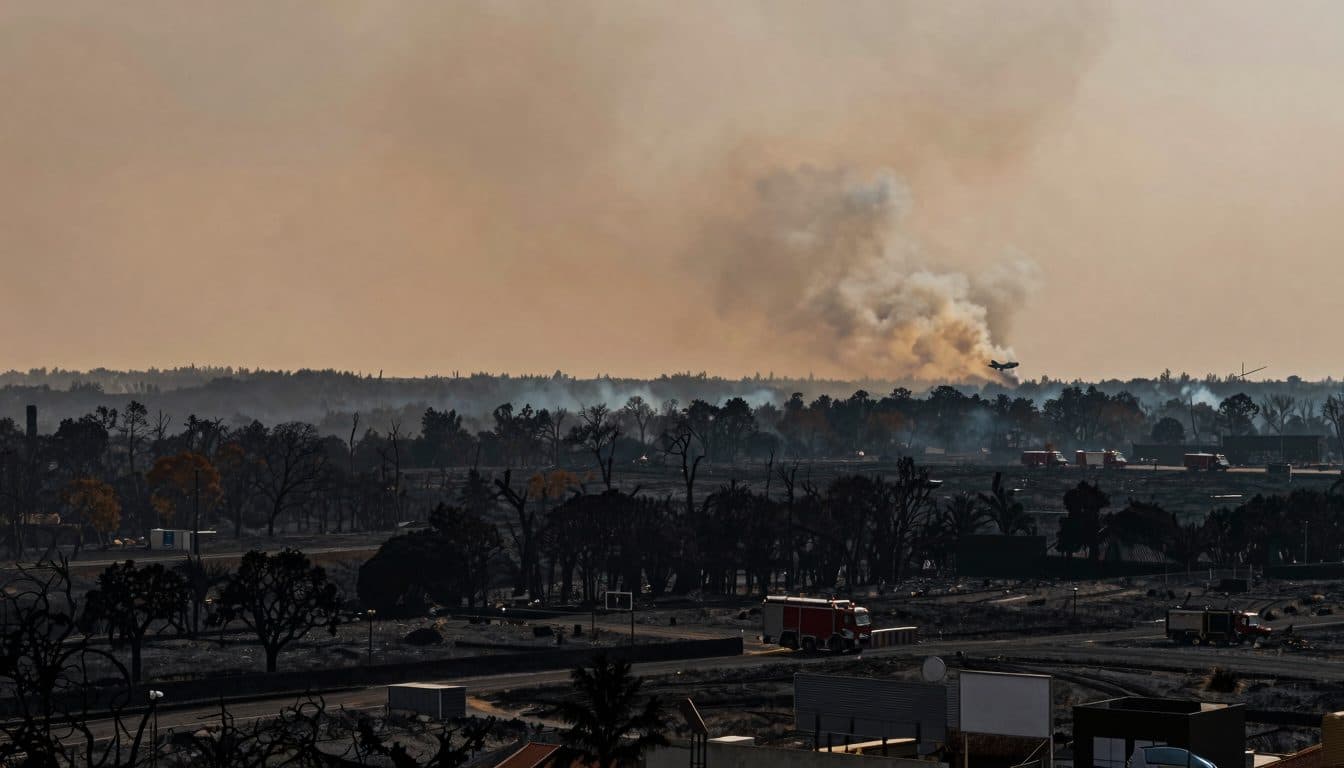
AI-generated image (z-image via Kie.ai)
Summary
The massive wildfire near Bordeaux has advanced to within 15 kilometers of the city and has destroyed around 42,000 hectares of forest. Since Wednesday, more than 220,000 people have been brought to safety, including many tourists; meanwhile, fires are raging in Spain and Portugal.
Bordeaux, 28 July 2026
The wildfire that has been raging in southwestern France for almost a week crept to within 15 kilometers of the major city of Bordeaux on 28 July 2026, destroying around 42,000 hectares of forest and brushland, while authorities evacuated some 4,000 additional tourists from the seaside resort of Lacanau on Tuesday.
Scale of the Destruction
Since last Wednesday, a wildfire has been spreading on the Atlantic coast in southwestern France, affecting the Gironde region and the neighboring département of Landes. According to the prefecture, the flames destroyed around 42,000 hectares of forest and brushland—an area of 420 square kilometers and thus larger than the city of Cologne. The area destroyed by the fire did not expand further on Tuesday, authorities said.
Since the weekend, however, firefighters have prevented further spread, and the situation has stabilized, according to reports. As the fire service explained in the morning, heat and wind are hampering the battle against the flames. Several nighttime flare-ups north of Le Porge and north of Cap-Ferret were able to be brought under control thanks to the deployment of the fire service, the responsible prefecture in Gironde stated.
In southwestern France alone, 2,500 firefighters, 18 firefighting aircraft, and 1,500 soldiers are deployed. In addition, 1,440 police forces are assisting. Support has arrived not only from large parts of France but also from abroad: Germany sent two transport helicopters and an A400M transport aircraft with equipment for an expected five days to the crisis region on Monday, 34 firefighters from Switzerland departed from Geneva to Bordeaux with fire engines on Saturday, and Turkey sent two firefighting aircraft.
International Assistance
The EU declared on Monday that it would send additional aircraft to combat the fires in Spain. "Currently nine aircraft are deployed on site, and tomorrow there will be eleven—provided from our European strategic reserve," said EU Commissioner Hadja Lahbib. A Canadair CL-415 firefighting aircraft from the French civil protection service is to help bring the situation under control.
Since Wednesday, more than 220,000 people have been brought to safety in the Atlantic coast holiday region, which is also popular with Germans, including many tourists. On Tuesday morning, the prefecture in Bordeaux ordered the evacuation of campsites and holiday villages in Lacanau and Lacanau Océan. Around 4,000 people are affected and were transported to Carcans and Castelnau-de-Médoc. Vacationers were instructed to take all their luggage with them and strictly follow the orders of the security forces. In Bordeaux, many of the evacuees are being accommodated in an exhibition center.
The major fire could last "several weeks, even several months" before it is fully extinguished, a fire officer told the broadcaster France Info. In the south of France, wildfires have broken out, and with the summer months and holiday season, it is normally peak season in the Gironde prefecture affected by the fire.
Political Reactions
French President Emmanuel Macron visited the operational and rescue command center (CODIS) in Bordeaux on Monday evening and spoke of the most severe situation since the Second World War. "The coming weeks will be hard," he warned. He said: "We will win this fight to protect the population" and praised "the remarkable work to protect the civilian population." Macron announced that forests would in future be reforested "differently," with plants and management adapted to the challenges of climate change.
French Interior Minister Laurent Nunez stated that the situation has stabilized, according to both the fire service and his ministry. However, the fire is far from under control. The situation remains difficult, Senator for the Gironde département Nathalie Delattre told broadcaster BFM TV on Tuesday. "Everything will depend on how the firefighters on the ground progress," she added.
In the area around Biscarrosse, roughly 40 kilometers to the south, the situation has meanwhile somewhat normalized following another wildfire last week. Around 15,000 people were able to gradually return to their homes and to a nearby campsite, according to the local administration. However, the positive development does not mean the danger has been averted. Flare-ups remain possible, particularly due to wind and dryness.
Spain is also continuing to be affected by large-scale wildfires in areas around the capital Madrid as well as north of Valencia. The wildfires are mainly hitting the province of Ávila west of Madrid as well as the neighboring regions of Madrid and Toledo. In Ávila alone, an area of nearly 50,000 hectares was destroyed according to preliminary official estimates. This corresponds to around 500 square kilometers—almost the area of Lake Constance. This fire is thus the largest in Spain's recent history, meaning since records began in 1968.
Situation in Spain
Since the weekend, the spread of the fires has at least slowed significantly. "Today we can be somewhat calmer, particularly given the weather conditions that await us in the coming hours," said Spanish Interior Minister Fernando Grande-Marlaska on Tuesday. "Thanks to the enormous effort of the helpers," progress has been made, but the firefighting work remains "in a critical phase." Spain has declared the affected areas disaster zones, allowing initial aid to flow in.
The authorities evacuated around 76,000 people, with another 30,000 instructed to remain in their homes. Around 90,000 people were most recently affected by evacuations or lockdown measures. Fires are also continuing in the province of Castellón in the east of the country. In the Vall d'Uixó area, the flames have so far consumed around 8,500 hectares. There, a total of around 16,000 people were evacuated, but around 6,000 were able to return to their homes on Monday due to the easing of the situation.
Spanish Prime Minister Pedro Sánchez called on "all citizens throughout the country to exercise extreme caution and take all possible precautionary measures." After a crisis committee meeting in Madrid, he said: "We see light at the end of the tunnel." The government would deploy all available resources "until the last flame." At the same time, he warned: "Denying man-made climate change is 'the worst fuel' in the fight against fires and the climate crisis." In total, eight major wildfires were raging in Spain on Tuesday. Since the beginning of the year, 175,000 hectares have already burned—six times the area compared to the same period last year.
Fires in Portugal
Several major wildfires are also burning in Portugal. In total, 34 wildfires were active across the country on Tuesday morning. However, all the fires are so far significantly smaller than in its Iberian neighbor. They were collectively being fought by just over 1,000 emergency personnel, supported by around twenty firefighting aircraft and helicopters. The largest fires are spreading, according to reports, near Braga and Bragança in the north as well as near Santarém in the center of the country.
With a renewed heatwave, a rise in temperatures and a drop in humidity are expected. For Wednesday, Météo France forecast a peak of 37 degrees in the region, and up to 40 degrees in the southwest of the country. This is expected across large parts of France during the day according to the Météo-France weather service. However, temperatures of up to 40 degrees Celsius are also expected in Spain. This will push the fire danger nationwide to a very high or extreme level, warned the Spanish weather service Aemet.
Weather Development
The new heatwave is expected to last until the end of the week. It is forecast for large parts of France during the day, according to the Météo-France weather service, and will bring temperatures of up to 40 degrees Celsius in the southwest of the country on Wednesday. From Wednesday, rising temperatures and freshening winds are expected again, according to the weather service, which is why the situation is likely to deteriorate again then.
The economic consequences are severe. "This is a heavy blow for a large part of the département, which is predominantly characterized by tourism—tourism has come to a complete standstill, the season is over," said Patrick Seguin, President of the Gironde Chamber of Commerce and Industry, to broadcaster BFMTV. Finance Minister Roland Lescure spoke of a "shock" for the regional economy, which is heavily dependent on wine-growing and tourism.
Economic Consequences and Consumer Rights
The rights of affected holidaymakers are also a topic. "In the case of a package tour, vacationers can cancel free of charge if unavoidable, extraordinary circumstances exist," explained Oliver Buttler from the consumer advice center in Baden-Württemberg. There is currently no official travel warning from the Federal Foreign Office, however. Consumer advocates emphasize that wildfires count as extraordinary circumstances when they have spiraled out of control and pose a major danger in the holiday region.
Questions & Answers
What is the current situation with the wildfire near Bordeaux?
The wildfire near Bordeaux has been stabilized according to the authorities, but is not yet under control. Since Wednesday, more than 220,000 people have been brought to safety, around 42,000 hectares of forest have burned, and the evacuation of around 4,000 tourists from Lacanau was ordered for Tuesday.
Which countries besides France are affected by the fires?
Spain is also battling major wildfires, particularly in the regions of Ávila, Madrid, Toledo, and Castellón. Around 90,000 people there were most recently affected by evacuations or lockdown measures.