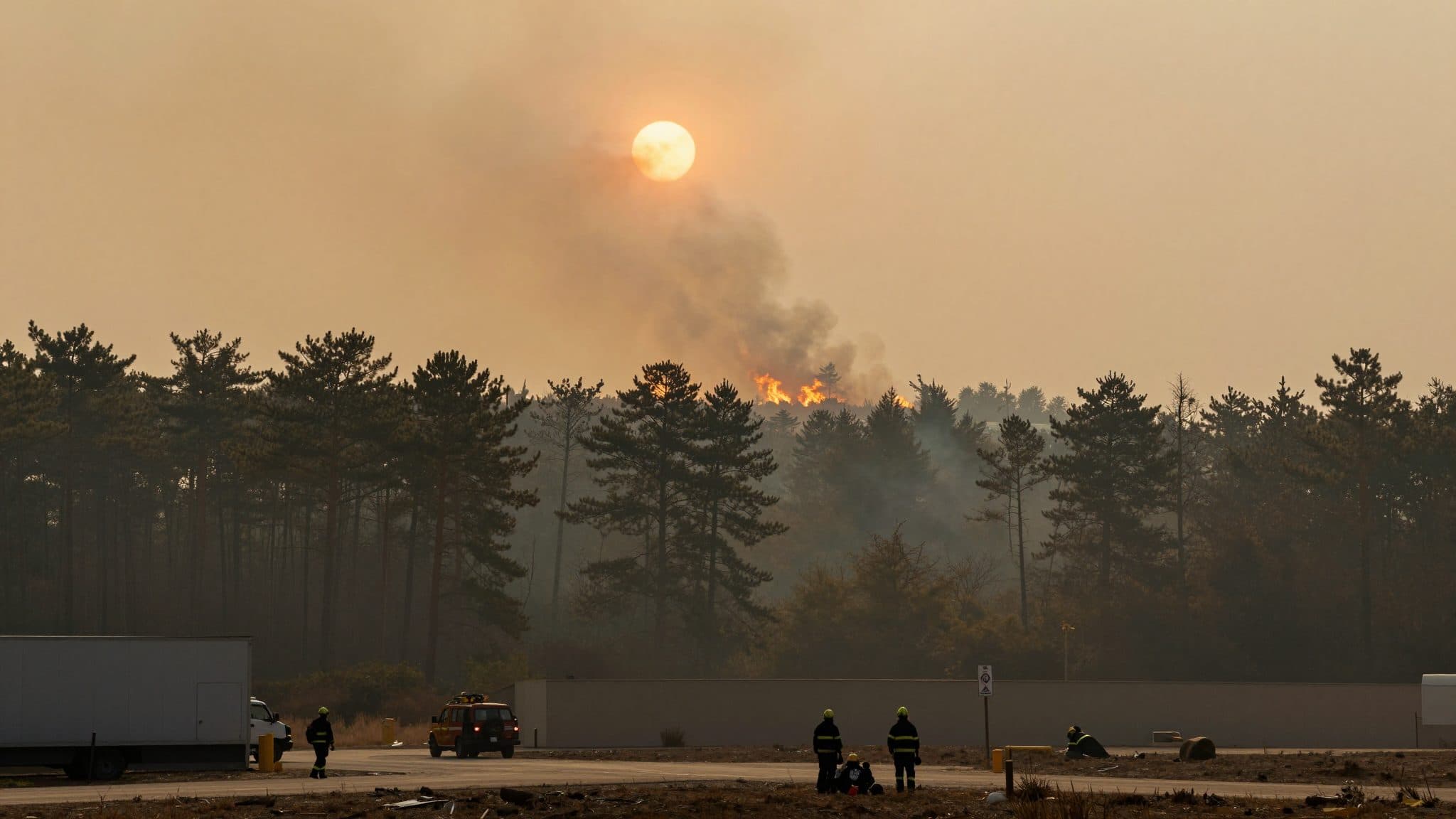
Wildfires Near Bordeaux: Hundreds of Thousands Evacuated, New Heat Wave Expected
Bordeaux, July 28, 2026
AI-generated image (z-image via Kie.ai)
Summary
The most severe wildfires since the end of World War II are raging in southwestern France. More than 220,000 people have already been brought to safety, while a new heat wave with temperatures of up to 40 degrees is further aggravating the situation.
Bordeaux, July 28, 2026
In southwestern France, thousands of emergency personnel are battling the most severe wildfires since the end of World War II; since Wednesday, more than 220,000 people have been evacuated along the Atlantic coast, while meteorologists are announcing a new heat wave with temperatures of up to 40 degrees Celsius.
Scale of the Destruction
The major fire in the Gironde department has now approached within up to 15 kilometers of the city of Bordeaux and destroyed around 42,000 hectares of forest and scrubland. That corresponds to an area of about 420 square kilometers – larger than the city of Cologne. According to the assessment of French President Emmanuel Macron, this makes the fire one of the most severe natural events to have struck the country in recent decades. Macron spoke of the "heftigsten Waldbränden seit Ende des Zweiten Weltkriegs" during a visit to the operations command in Bordeaux on Monday evening.
According to the authorities, around 2,500 firefighters, 18 firefighting aircraft, and approximately 1,500 soldiers are deployed. The German Bundeswehr dispatched two transport helicopters and one A400M transport aircraft with equipment to the crisis region on Monday afternoon; the mission is expected to last five days. Switzerland is also providing official assistance: as early as Saturday, 34 firefighters with fire engines had set off from Geneva to Bordeaux; their deployment is expected to last until the beginning of August.
Emergency Personnel and International Aid
According to fire service officers, the situation remains critical. One officer told the broadcaster France Info that the major fire could last "mehrere Wochen, ja sogar mehrere Monate andauern" before being fully extinguished. French fire service spokesperson Eric Brocardi described the conditions as a "kriegsähnliches Szenario, bei dem wir ständig unter Beschuss sind und uns alle in Sicherheit bringen müssen". Confirmed by French experts, a so-called pyrocumulonimbus – a massive cloud formation that generates its own winds and carries lightning – formed for the first time in Europe over the fire area. This phenomenon had previously been known mainly from Australia and the United States.
On Monday morning, government spokesperson Maud Bregeon urgently urged the public not to travel to the Gironde as long as the fire was not under control. Macron, at the same time, expressed confidence that the fire could be managed: "Wir werden diesen Kampf zum Schutz der Bevölkerung gewinnen", he said, praising "die bemerkenswerte Arbeit zum Schutz der Zivilbevölkerung".
Economic Consequences
The economic consequences are already severe. Patrick Seguin, president of the Gironde Chamber of Commerce and Industry, told the broadcaster BFMTV: "Das ist ein schwerer Schlag für einen Großteil des vorwiegend vom Tourismus geprägten Departements – der Tourismus ist komplett zum Erliegen gekommen, die Saison ist vorbei." In the region popular with German tourists around Biscarrosse, Lège-Cap-Ferret, and Cap Ferret, numerous campsites and beaches were cleared.
Severe fires are also raging in parallel in Spain. The province of Ávila west of Madrid and the neighboring regions of Madrid and Toledo are particularly affected; there, the flames have destroyed a combined nearly 80,000 hectares of forest and scrubland. In the province of Ávila, around 5,000 residents had to be evacuated. In the eastern Spanish province of Castellón, around 16,000 people left their homes. Across Spain, around 90,000 people are affected by evacuations or curfews.
Portugal has also been battling several wildfires since Monday. In the center and north of the country, near Braga, Bragança, and Santarém, flames are raging in scrubland. More than 1,000 firefighters are deployed, supported by around 20 firefighting aircraft and helicopters. The Portuguese weather service has warned of very high to extreme fire danger in nearly all parts of the country; only along the coasts is the danger somewhat lower. In the north and center, temperatures of around 39 degrees Celsius are expected.
Heat Wave as a Fire Accelerator
The meteorological situation is expected to worsen further. The French weather service Météo-France expects a new heat wave across large parts of France over the course of Tuesday; on Wednesday, temperatures of up to 40 degrees are forecast for the southwest. Temperatures of up to 40 degrees are also expected in Spain. Spain's Prime Minister Pedro Sánchez called on "alle Bürger im ganzen Land dazu auf, äußerste Vorsicht walten zu lassen und alle möglichen Vorsichtsmaßnahmen zu treffen".
Scientists see a direct link to climate change. Juli G., a Spanish climate expert, said: "Sobald wir als Gesellschaft akzeptiert haben, dass wir das Klima verändern, werden diese Brände Teil der neuen Normalität; mit anderen Worten: Sie sind genau das, was wir erwartet haben." Pausas of the research center CIDE in Valencia warns: "Seit Jahrzehnten wird davor gewarnt, dass die Folgen sehr schwerwiegend sein könnten, wenn wir die Temperaturen weiter in die Höhe treiben." During the current heat waves, "fast jede Art von Vegetation in Brand geraten" can.
Scientists Warn of a New Normal
Theodore Keeping, a wildfire expert from Imperial College London, described the fires in Spain and France as "Feuer, die mit der Intensität von mehreren Atombomben brennen". Keeping explained to the British Science Media Centre that the fires ranked "zu den extremsten, die wir je in Europa erlebt haben – sowohl hinsichtlich ihrer Ausdehnung als auch der Ausbreitungsgeschwindigkeit und der dadurch ausgelösten Pyrocumulonimbus-Stürme". Víctor Resco de Dios, a wildfire expert from the Spanish University of Lleida, spoke of an "Intensität von mehreren Atombomben".
Another risk factor is the health consequences. Elisabeth Dietze from the University of Göttingen pointed out that ecological damage is "kaum berücksichtigt": "Durch Vegetationsverbrennung können gesundheitsgefährdende Stoffe entstehen, die unter anderem sowohl die Luft- als auch die Wasserqualität beeinflussen können." The runoff dynamics on wildfire areas also change; after major fires, this can affect flood protection in low mountain ranges. Estimates worldwide suggest more than 100,000 additional deaths per year due to wildfire smoke exposure.
Meanwhile, emergency personnel are trying to stabilize the fronts. According to the authorities, the smaller of the two fires near Bordeaux is now under control; but the larger fire continues to cause major difficulties for the rescue forces. The fire service spokesperson said: "Eine vollständige Bekämpfung von Bränden dieser Größenordnung ist nicht möglich, ohne dass das Feuer deutlich nachlässt, und die Rückkehr sehr heißer Bedingungen in den kommenden Tagen macht eine weitere Ausbreitung dieser Brände wahrscheinlich."
Health and Ecological Risks
Comparable fires in Europe had already caused severe damage in June of this year. A wildfire in central Portugal had destroyed around 13,000 hectares just under a month ago. In France, 10,000 hectares burned last weekend alone on Saturday and Sunday. In the province of Ávila near Madrid, the flames destroyed around 70,000 hectares according to the latest figures.
The evacuations have reached enormous proportions. According to the latest figures, more than 220,000 residents and tourists have been brought to safety – many of them from the Atlantic coastal holiday region popular with Germans. In Spain, the total is around 90,000 people affected. The authorities have set up emergency accommodations in schools and sports halls; a return to the evacuated areas is not in sight for the time being.
International solidarity is strong. In addition to Germany and Switzerland, other European states have also offered support. The EU Commission is coordinating the aid through the Civil Protection Mechanism. French President Macron announced that assistance would be further intensified. At the same time, concern is growing that the fires could spread to other parts of the southwest if the announced heat wave further fuels the flames.
The medium-term consequences for the affected regions are not yet foreseeable. In addition to the direct damage to forests and infrastructure, experts fear long-term effects on biodiversity, the water balance, and soil erosion. The responsible authorities in France and Spain have announced soil samples to investigate contamination by heavy metals and other pollutants. Reforestation is likely to take years.
The situation remains tense: with temperatures of up to 40 degrees Celsius and persistent drought, meteorologists expect a further deterioration of conditions in the coming days. The fire service is calling on the public to report any smoke development immediately and to stay away from the fire areas. According to the respective weather services, the wildfire danger is also elevated in Switzerland, Austria, and Italy.
The French weather service Météo-France has issued Orange-level heat warnings for large parts of the country. Extreme heat warnings are in effect in several provinces in Spain. Both countries have placed their emergency personnel on the highest alert. Portugal is also preparing for a further deterioration of the situation. The EU authorities are monitoring the developments and stand ready to deploy additional firefighting aircraft and helicopters from the EU Civil Protection Pool if needed.
Questions & Answers
Why are the fires near Bordeaux so extraordinary?
According to the assessment of French President Emmanuel Macron, this is the most severe wildfire in France since the end of World War II. The fire has approached within around 15 kilometers of