E-Scooter Accidents in Germany: 38 Dead and Tens of Thousands Injured in the Past Year
Wiesbaden, July 16, 2026
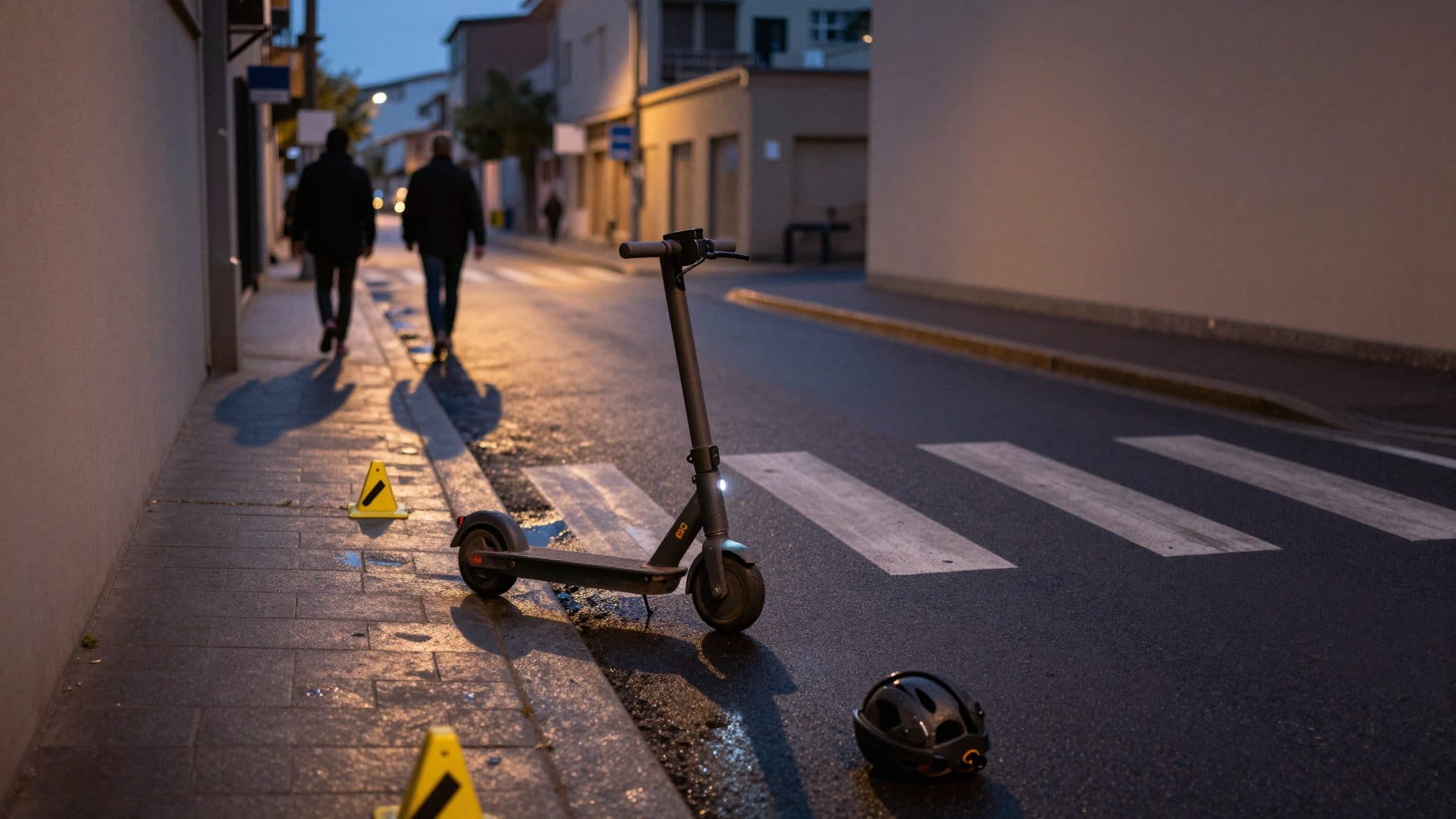
AI-generated image (z-image via Kie.ai)
Summary
In the past year, 38 people died in Germany in accidents involving e-scooters – eleven more than the previous year. Police registered around 16,500 accidents involving personal injury, an increase of 38 percent compared to 2024.
Wiesbaden, July 16, 2026
In accidents involving e-scooters in Germany, 38 people lost their lives in the past year, eleven more than the year before – at the same time, the number of police-recorded accidents involving personal injury rose by around 38 percent to 16,496 cases.
Figures from the Federal Statistical Office
The Federal Statistical Office (Destatis) announced this in Wiesbaden. According to the figures, 38 people died in accidents involving an e-scooter – eleven more than the previous year. Of the five other people killed in e-scooter accidents, three were on foot, one was on a bicycle, and one was in a car.
In addition, there were 1,895 seriously injured and 16,184 slightly injured persons. Overall, police in Germany registered 16,496 such accidents last year – around 38 percent more than in 2024. This means the number of e-scooter accidents with injuries and fatalities has nearly tripled since 2021.
Young people are particularly affected: more than half were under 25 years old, and almost 84 percent of those injured were under 45. Only 3.1 percent belonged to the 65-plus age group. E-scooter riders were involved in 5.5 percent of all traffic accidents involving personal injury.
Children and Adolescents Particularly Affected
In 2025, 5,014 children and adolescents aged under six to 18 were injured in accidents involving e-scooters in Germany. Five young people died in the accidents, and 438 were seriously injured. On average, more than 2,500 children and adolescents under 18 are injured in accidents with the electric scooters in this country each year. Adolescents aged 15 to under 18 are most strongly represented.
The German Society for Pediatric and Adolescent Surgery (DGKJCH) explained that adolescents between 15 and 18 are particularly frequently affected. In the age group up to 15, the increase in accidents is 120 percent. Of those under 15, 1,520 adolescents were the cause; in the 15-to-18 age group, 1,870 young people were the cause.
The most common cause of accidents among e-scooter riders, according to the statisticians, was incorrect use of roadways or sidewalks, accounting for 21.6 percent. The third most frequent improper behavior was inappropriate speed – followed by errors when turning, reversing, and pulling in or out.
Causes of Accidents: Paths, Speed, Alcohol
In collisions with cyclists, the e-scooter riders were the main cause in slightly more than 74 percent of cases. Although e-scooter riders were the main cause in collisions with cars in only 38 percent of cases, they were the main cause in 74 percent of accidents with cyclists, and in as many as 89 percent of accidents with pedestrians.
Alcohol also plays a significant role: it was the cause in 10.9 percent of cases, more frequently than among cyclists at 7.7 percent. Last year, this figure was almost eleven percent. For those under 21 and new license holders, the zero-promille limit applies anyway; in general, the limit is 0.5 promille.
Nearly half of serious accidents occur without any external cause: rather, loss of balance or incorrect self-assessment is the reason. Of the 33 fatally injured e-scooter riders, nearly half died in single-vehicle accidents. Accidents with e-scooters occurred primarily in major cities.
Passengers and Single-Vehicle Accidents
Among those injured were also 822 passengers, although this is prohibited. One of them died. More than five percent of those injured were passengers; of these, 49 were adolescent passengers, most of them aged between 10 and 18. Just over four out of five of those injured were riding the e-scooter themselves.
In falls, dangerous head injuries, abdominal injuries, and fractures of the torso are particularly likely. In the night leading into Wednesday, another e-scooter rider died in an accident in Berlin-Kreuzberg. The fact that the small wheels react very sensitively to potholes, curbs, or wet leaves also contributes to the high accident rate.
Demands: DVR and DGKJCH
The German Road Safety Council (DVR) called for the introduction of an e-scooter certification requirement for all road users who do not possess a driver's license. It is calling, on the one hand, for raising the age limit for e-scooter riders from 14 to 15 years and for more controls; raising the minimum age would once again ensure parity with mopeds or small motorized vehicles, the DVR argues.
In addition, a certification requirement should be introduced – modeled on the moped test certificate. Because e-scooter riders are particularly difficult to see during twilight or in the dark when they cross roadways, the DVR also advocates for yellow side marker lights on the devices.
The German Society for Pediatric and Adolescent Surgery is calling for a ban on e-scooters for children under 14, as well as a mandatory helmet requirement. In addition to a helmet requirement, the society recommends safety training tailored to children and adolescents. These are offered by, among others, the ADAC, the German Traffic Watch (Deutsche Verkehrswacht), or the police. The Verkehrswacht, for example, bundles information, materials, and training on its new platform ScootSkills.
"It is alarming that in e-scooter accidents, children and adolescents strikingly often suffer severe injuries," the specialist society stated. "Contrary to the perception of them as harmless toys, e-scooters have replaced the trampoline as the most common cause of severe recreational injuries in pediatric and adolescent surgery," said DGKJCH spokesperson Joachim Suß, Chief Physician for Pediatric Surgery at the Children's Hospital Wilhelmstift in Hamburg.
"This carries a high accident potential that we must avoid through education, protective measures, and rules," emphasized DGKJCH President Guido Seitz. Children under 14 are inexperienced, not sufficiently familiar with traffic rules, and often overestimate themselves.
Tougher Liability and Political Debate
The TÜV Association (TÜV-Verband) demanded, in view of the figures, that higher fines and stricter liability regulations must be strictly enforced. E-scooters should become an integral part of traffic education. Riding safety training, similar to cycling instruction, during school years could particularly help young users better assess risks and control their vehicles safely.
The Bundestag recently passed stricter liability rules. Because of the rising number of accidents, the government is tightening liability for e-scooters. Victim protection in road traffic is to be significantly improved. Anyone who, for example, is hit by a vehicle or trips over a parked e-scooter should in future be able to receive compensation more easily. In future, claims for damages should be easier to assert against the rental company in the event of accidents.
The political debate on the parking of scooters is also taking shape: In favor is Berlin's Senator for Transport Ute Bonde (CDU). Against is Dustin Williams, representative of the Shared Mobility platform. E-scooter riders must – where available – use bike lanes or protected lanes and otherwise use roadways or shoulders. Riding on sidewalks is prohibited. E-scooters may only be ridden alone and only from the age of 14. E-scooters are only approved for one person – riding as a passenger is prohibited.
This news was broadcast on 16.07.2026 on Deutschlandfunk. They make up just under three-quarters of all e-scooters: 1.4 million were already in use in 2023, and the trend is rising. For comparison: in 2025, 462 people died in around 97,000 bicycle accidents; police registered a total of 297,364 traffic accidents involving personal injury.
Questions & Answers
How many people died in e-scooter accidents in Germany in the past year?
According to the Federal Statistical Office, 38 people died in accidents involving an e-scooter, eleven more than the previous year.
What demands is the German Society for Pediatric and Adolescent Surgery making?
The DGKJCH is calling for a ban on e-scooters for children under 14, a mandatory helmet requirement, and targeted riding training for young users.
What did the Bundestag decide regarding liability for e-scooters?
The Bundestag has passed stricter liability rules so that victims can more easily receive compensation in future – for example, if they are hit by a vehicle or trip over a parked e-scooter.