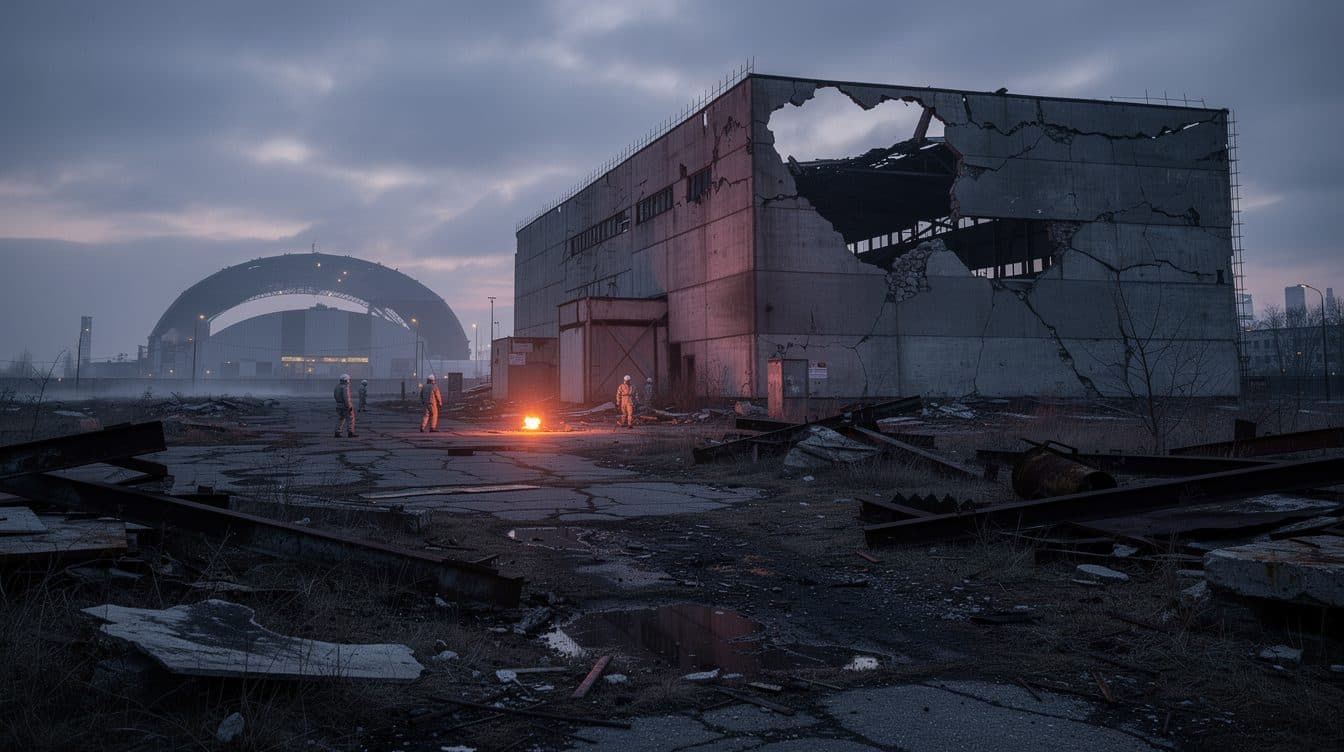
AI-generated image (flux-2/pro-text-to-image via Kie.ai)
Summary
A Russian drone struck a container reception building at the central spent fuel storage facility in the Chernobyl exclusion zone early on 7 June 2026, partially destroying the structure. Ukrainian state nuclear company Energoatom and the IAEA said no spent fuel was stored in the building and that radiation levels remained normal. The incident is expected to be discussed at a meeting in London involving the leaders of Ukraine, Germany, France and Britain.
Kyiv, 7 June 2026
A Russian drone struck a building at the central spent nuclear fuel storage facility in the Chernobyl exclusion zone overnight into 7 June 2026, Ukrainian authorities and the International Atomic Energy Agency (IAEA) said, prompting calls for an expert inspection and renewed international condemnation.
Ukraine's state nuclear company Energoatom reported the strike via Telegram in the early hours of Sunday, saying the building used to receive containers at the central storage facility in the Chernobyl exclusion zone was partially destroyed. The damaged structure is located roughly 15 kilometres from the former Chernobyl Nuclear Power Plant and is part of a complex used for the long-term storage of spent fuel elements from other Ukrainian nuclear power plants. Energoatom stressed that the building did not contain spent nuclear fuel at the time of the attack, and said: 'Es sei dort aber kein abgebrannter Kernbrennstoff gelagert worden.'
A fire broke out at the site and spread over an area of around 40 square metres before being extinguished, the company said. Energoatom added that the radiation situation at the Chernobyl site remained within established limits. The IAEA later confirmed after an inspection that radiation values were normal and that no radioactive contamination had been detected. Ukraine's General Staff and the state nuclear authority both reported that no injuries resulted from the Chernobyl-area drone strike.
The IAEA said it had been informed by the Ukrainian side of significant damage to the building, including to its facade, windows and doors, and that neighbouring buildings had also been affected by the blast wave. Director General Rafael Grossi wrote on X that the incident was 'zutiefst beunruhigend' and 'extremely concerning' because of the proximity of the attack to large quantities of stored nuclear material. 'Der Vorfall sei äußerst besorgniserregend, da er sich in einer Liegenschaft ereignet habe, wo große Mengen an Kernmaterial gelagert seien - nur wenige Meter vom angegriffenen Gebäude entfernt,' Grossi said, adding that the agency would send a team of experts to the site.
IAEA reaction and inspection
Grossi also stressed the wider principle at stake. 'Angriffe auf kerntechnische Anlagen seien völlig inakzeptabel und verstießen direkt gegen zentrale Grundsätze der nuklearen Sicherheit während eines militärischen Konflikts,' he said. The IAEA chief later called such attacks 'wie ein Spiel mit dem Feuer' and said he was seriously concerned. The agency said the incident at Chernobyl, combined with a separate hole torn in a wall at the Russian-occupied Zaporizhzhia nuclear power plant, highlighted the risks to nuclear sites in the war zone. The IAEA noted the Zaporizhzhia strike was the first drone impact inside the plant's grounds since April 2024 and said it had requested access to the affected turbine hall.
Ukrainian and international response
Ukrainian President Volodymyr Zelensky confirmed on X that a building of the central spent fuel storage facility had been hit and accused Russia of deliberately targeting the site. 'Russland habe eine Anlage der 'kritischen Infrastruktur' gezielt angegriffen,' he wrote, describing the attack on Telegram as an 'außerordentlich hinterhältigen russischen Angriff' and 'extrem niederträchtig'. Zelensky said that as of his statement there were no elevated radiation readings but sharply criticised Moscow: 'Selenski kritisierte Russland scharf und sprach von einer «Überschreitung der ohnehin schon himmelhohen Unverschämtheit».' He also said the relevant ministries and services in Kyiv had informed international partners about the incident.
Pattern of incidents at nuclear sites
Foreign Minister Andriy Sybiha said on X that this was 'nicht das erste Mal, dass russische Streitkräfte die ukrainischen Atomanlagen in Gefahr bringen'. The Chernobyl strike came against the backdrop of repeated incidents at Ukrainian nuclear sites during the Russian invasion. In the previous year, the new sarcophagus covering the destroyed reactor at Chernobyl was hit by a Russian drone and sustained lasting damage, and the Zaporizhzhia nuclear power plant — the largest in Europe and now occupied by Russia — has been particularly affected by the fighting. An important power line at Zaporizhzhia was recently restored after a 15-hour outage during which the plant had to rely on emergency diesel generators to cool its six shut-down reactors.
London meeting of European leaders
The Chernobyl strike is expected to be a major topic at a meeting scheduled in London for Sunday evening, attended by Zelensky, German Chancellor Friedrich Merz, French President Emmanuel Macron and British Prime Minister Keir Starmer. According to Paris, the talks will also cover increased pressure on Russia. The European leaders aim to coordinate positions on possible negotiations to end the war, which has lasted more than four years, and want to be at the table in the event of ceasefire talks. On Friday, Kremlin chief Vladimir Putin had rejected a summit meeting proposed by Zelensky, who accused Putin of 'einfach nicht beenden' the war.
Russia's response and the Schröder meeting
Russia's Defence Ministry said only that strikes had been carried out on targets connected to the Ukrainian army and provided no further information about the Chernobyl incident. Figures from both sides of the conflict cannot be independently verified. Amid the nuclear-safety concerns, Russian President Vladimir Putin met former German Chancellor Gerhard Schröder in the Kremlin, a meeting the Kremlin described as 'ein gutes Gespräch' but disclosed no content. Putin had previously suggested Schröder as a possible mediator for talks between Russia and Europe.
Overnight strikes across Ukraine and Russia
The wider pattern of attacks during the night underlined the continuing intensity of the war. Ukraine's Air Force said Russia attacked overnight with one missile, six cruise missiles and 290 drones, of which 284 were intercepted, with hits reported at seven locations and debris falling at ten. Ukraine said 236 drones were launched during the night to Sunday, of which 215 were intercepted. The Russian Defence Ministry said it had intercepted 95 Ukrainian drones during the same period. Across the country, Russian strikes killed at least two people overnight, including a 59-year-old man in the Dnipropetrovsk region, according to regional governor Oleksandr Hanscha, and a 56-year-old minibus driver in the southern Zaporizhzhia region, according to the state emergency service. A 35-year-old man was injured in the Dnipropetrovsk region, and a glide bomb killed three people in a village in the Zaporizhzhia region, authorities said. A Russian drone attack on a bus stop in the Zaporizhzhia region killed three people and injured others, and in the city of Zaporizhzhia itself one person was killed and two injured, according to regional governor Ivan Fedorov. Three people were injured in Kherson.
Ukrainian counter-strikes into Russia also continued, with Kyiv targeting oil and energy infrastructure important to Moscow's war financing. Zelensky confirmed an attack on an oil depot in the southern Russian Krasnodar region, where a fire broke out in Armavir, and on a military base near St. Petersburg, thanking soldiers for their accuracy via Telegram. 'Die Ukraine bringe den Krieg völlig gerechtfertigt dahin zurück, woher er gekommen sei,' he wrote. The Ukrainian General Staff confirmed strikes on the Russian port of Taganrog, where a tanker, a fuel tank and an administrative building caught fire, injuring two people, according to Governor Yuri Slyusar. Russia claimed to have intercepted hundreds of Ukrainian drones during the week, including dozens near St. Petersburg, where an international economic forum was being held in Putin's hometown.
Air raid warnings and Western support
Zelensky renewed a warning from the previous day about a possible new massive Russian air attack, telling Ukrainians not to ignore air raid alerts. 'Die Information des Geheimdienstes über einen möglichen massiven Angriff bleibt aktuell,' he said in a video address, acknowledging problems with Western supplies for defence against ballistic and cruise missiles. According to Zelensky, since the start of the week Russia has used 88 missiles, more than 3,250 combat drones and around 1,800 glide bombs. German Foreign Minister Johann Wadephul, visiting Mexico City, pledged continued support to Ukraine after Putin's rejection of a direct meeting: 'Deutschlands Hilfe für die Ukraine bleibe unerschütterlich.'
Background: the 1986 disaster
The Chernobyl disaster itself occurred on 26 April 1986, when a test at the nuclear power plant in the then-Soviet republic of Ukraine went out of control, producing the worst nuclear accident possible. Radioactive clouds from the disaster spread in attenuated form as far as Northern and Western Europe. The exclusion zone around the plant, declared after the accident, has since been the location of long-term spent fuel storage and other nuclear facilities, making any military incident there a matter of international concern. The exact intent behind the latest strike remained unclear, with the IAEA and Ukrainian officials describing it as a serious breach of nuclear safety principles during armed conflict.
Questions & Answers
What did the Russian drone hit at the Chernobyl site?
A Russian drone struck a building used for receiving nuclear waste containers at the central spent fuel storage facility in the Chernobyl exclusion zone, partially destroying the structure, according to Energoatom.
Was any radioactive material released by the strike?
Energoatom and the IAEA said the building did not contain spent nuclear fuel at the time of the attack, and that radiation values remained within normal limits and no contamination was detected.
How did the IAEA react to the Chernobyl strike?
IAEA Director General Rafael Grossi called the incident 'deeply concerning' and 'extremely concerning', said attacks on nuclear facilities are 'completely unacceptable', and announced that an IAEA team of experts would visit the site to assess the damage.